V ValkenRoot The Union Ledger

Project Portfolio

ValkenRoot

Codename: The Union Ledger

Game Application Designed and Developed by Nerdy Tech Geeks

This site is structured as a professional project portfolio for ValkenRoot. It explains what was built at each version, what design and technical thinking shaped it, how the architecture matured, and why the project was rebuilt into the current V1.0 direction.

Executive Summary

Project overview

Project trajectory

ValkenRoot began as a dark industrial fantasy concept and progressively evolved into a structured application and platform design. Each version clarified gameplay identity, world systems, product surfaces, infrastructure, and operational maturity.

V1.0 is the first version that formalizes the project as a fullstack platform with explicit boundaries, importer-driven content, disciplined delivery, and architecture shaped around long-term runtime and operations needs.

What this portfolio is meant to show

  • How the project evolved from concept to platform
  • What changed in the application and infrastructure from version to version
  • Why architectural decisions were made at different stages
  • How planning, content, governance, and operations were intentionally separated
  • That the current V1.0 direction is the result of cumulative design reasoning
Versions documented 8
Versioned app diagrams 8
Versioned infra diagrams 8
Supporting platform diagrams 4

Current Lead Version

V1.0 overhaul

This is the current version and the one that reflects what is actively being built now. It stays at the top because it shows the present state of the work. The versions below explain how the project got here.

What changed in V1.0

  • Planning and system design were completed formally.
  • The project moved to a monorepo with explicit app and package boundaries.
  • Schema, importer, seed flow, and release-aware content structure were established.
  • Gameplay, governance, and operations were separated into clearer architectural layers.
  • Observability and monitoring were treated as first-class future requirements.

Why it changed

Earlier versions proved the world and product ambition, but they also showed that the project needed stronger boundaries to scale. V1.0 exists because world complexity, runtime goals, data depth, and live operations demands could not safely keep growing inside a looser prototype structure.

The rebuild was driven by the need for repeatable imports, deliberate service ownership, environment-aware deployment, future simulation work, and a structure that could support both creative world design and disciplined engineering delivery.

Planning and execution thinking

The V1.0 direction was built from the inside out. First came system planning, source data modeling, handoff structure, and operational roles. Then came the implementation foundation: repository, CI/CD, schema, local stack, importer, seeded data, and the first API surfaces.

That sequence was intentional. It reduced rework and forced the project to grow on real content and real boundaries instead of placeholder mocks.

What is already complete in V1.0

  • Planning, data-pack authoring, and handoff completion
  • GitLab repository and CI/CD foundation
  • `pnpm` + Turborepo monorepo bootstrap
  • Initial Prisma schema and migration
  • Docker service stack for local foundation work
  • NestJS API bootstrap
  • Foundation importer
  • First seeded data wave and initial read-path modules
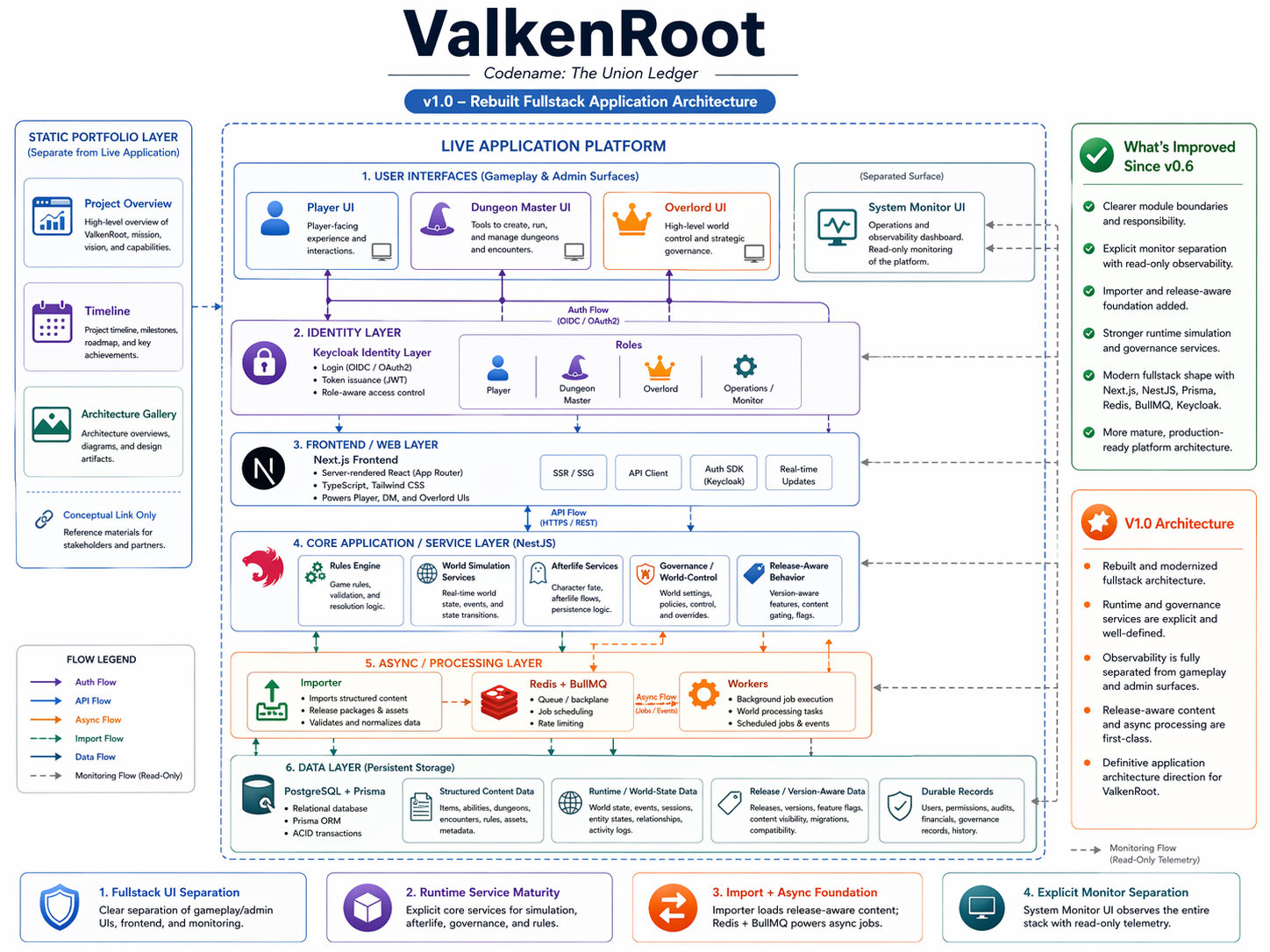
V1.0 application architecture diagram for ValkenRoot
V1.0 application architecture Shows the rebuilt service structure: separated interfaces, identity, API ownership, async layers, importer flow, rules engine direction, and monitoring isolation.
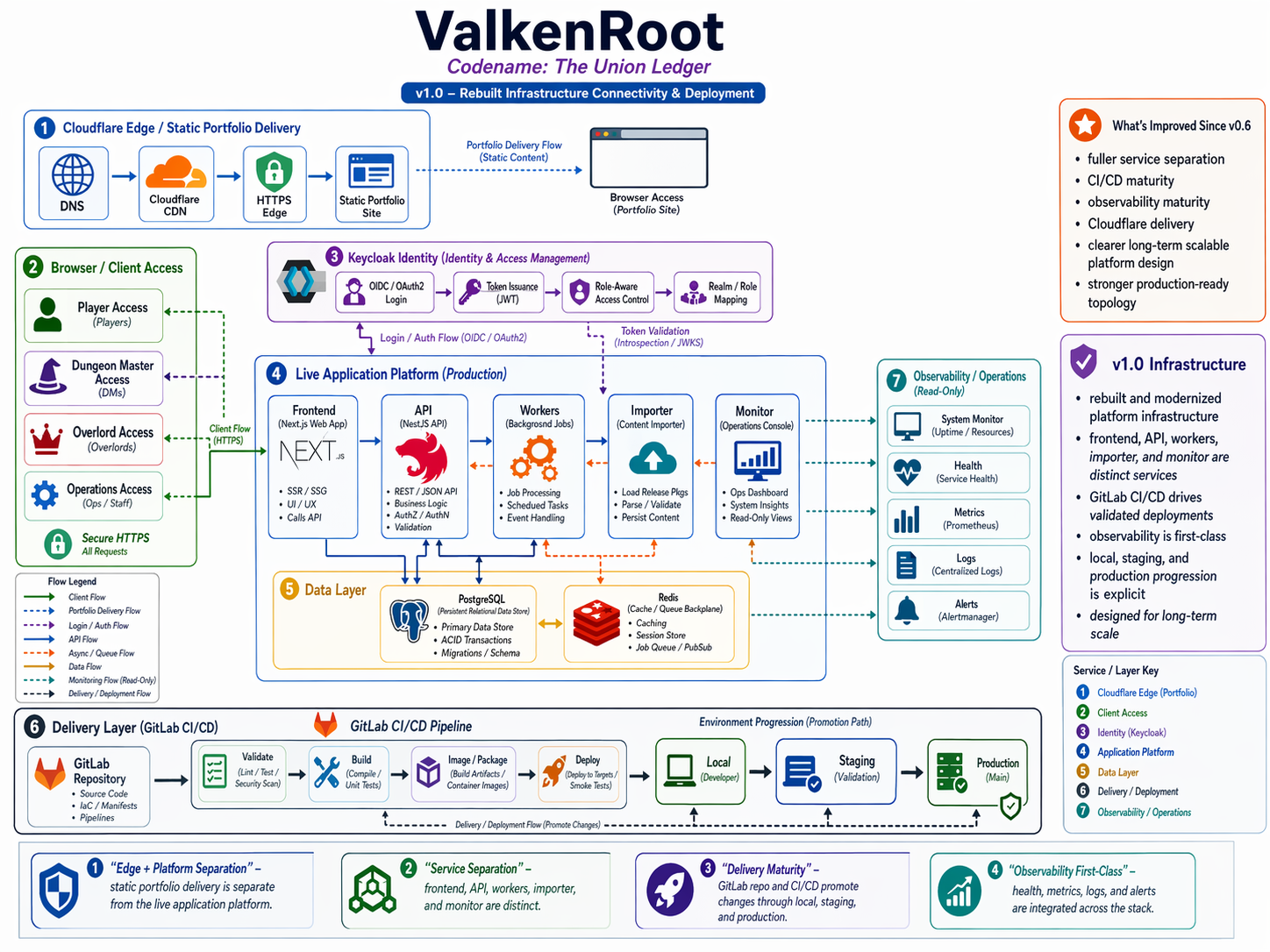
V1.0 infrastructure connectivity diagram for ValkenRoot
V1.0 infrastructure connectivity Shows the modern platform intent: delivery edge, authentication, application services, queues, observability, GitLab CI/CD, and environment progression.

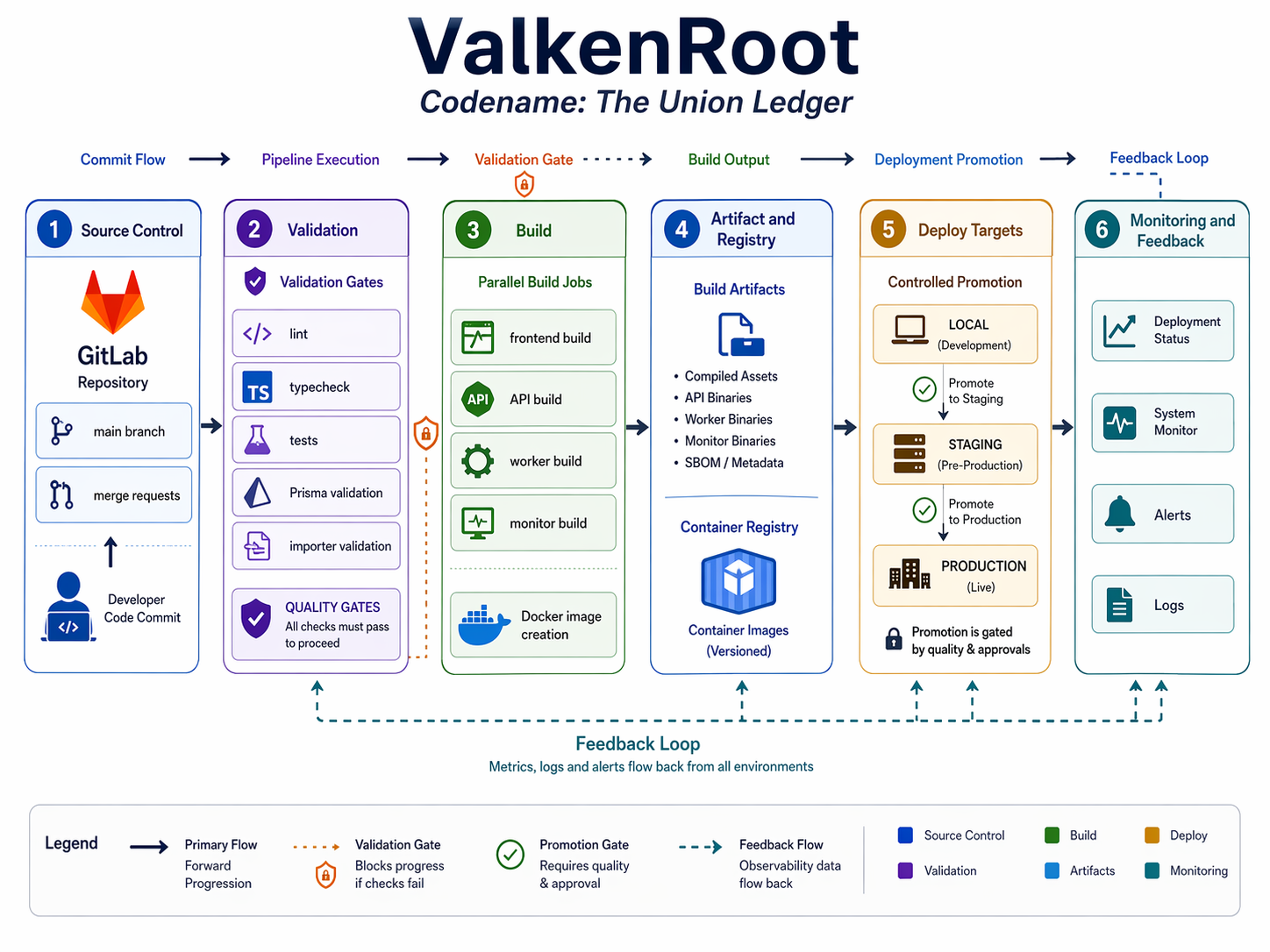
CI/CD delivery model in V1.0

V1.0 formalizes delivery around GitLab CI/CD so the project can move from local engineering work into repeatable validation, packaging, and deployment. Delivery is treated as part of the architecture, not as a final-step add-on.

That means source control, validation gates, build outputs, container packaging, environment promotion, and operational visibility are designed as one connected system.

How the pipeline works

  • GitLab acts as the central source of truth for repository history, merge flow, and pipeline execution.
  • Each pipeline validates the monorepo through linting, type checks, tests, and package builds.
  • Backend stages validate Prisma schema integrity, migrations, importer logic, and seed/runtime contracts.
  • Successful pipeline runs produce deployment-ready artifacts and container images.
  • Those images become the standard runtime units for local, staged, and production-style environments.

Docker and Kubernetes deployment path

Docker is the immediate packaging and runtime target for the web app, API, workers, monitor, and support services. It gives ValkenRoot a predictable delivery baseline for local development, controlled staging, and repeatable environment setup.

Kubernetes is the scaled deployment target once the platform grows into a fuller operational model. The same validated images and service boundaries move forward into orchestrated deployment, service discovery, scaling, and environment isolation.

End-state delivery intent

  • Code enters through GitLab repository and merge workflows.
  • GitLab CI validates quality, builds the system, and checks data/runtime contracts.
  • Approved builds are packaged as Docker images for stable deployment.
  • Docker-based delivery supports local and straightforward staged environments first.
  • The same service model extends into Kubernetes for broader production orchestration.
  • Monitoring and system visibility remain attached to the deployment path from the start.
V1.0 GitLab CI/CD flow for ValkenRoot including Docker and Kubernetes deployment targets
V1.0 CI/CD and deployment flow Shows the GitLab validation pipeline, build stages, artifact flow, Docker delivery, and the path into Kubernetes-based deployment.

Approach

How and why the project was shaped this way

Content-first, not mock-first

The implementation path was designed to grow on imported source data rather than placeholder mocks. That is why the importer, schema, seed waves, and release-aware content flow were prioritized early in V1.0.

Separate creative, runtime, and operations concerns

ValkenRoot is not only a player-facing surface. It also requires governance, simulation, and operational visibility. Those concerns were deliberately separated so player experience, admin control, and system monitoring do not collapse into one unsafe interface.

Use auth and observability as foundations

Identity, role boundaries, and monitoring were treated as architecture requirements, not optional additions. That thinking is visible in both the planning structure and the current V1.0 diagrams.

Prove each layer before scaling

Each version proves something different: concept, gameplay identity, world scale, platform direction, system layering, runtime ambition, staged validation, and finally formal rebuild. The history shows how the project matured.

Version Progression

How it started and how it progressed into current work

V1.0 stays on top because it reflects what is currently being built. After that, the sections below are arranged in progression order so the story reads from the beginning forward: how ValkenRoot started, what changed at each version, and how each stage fed the next.

v0

Original concept

The first version established the creative identity of ValkenRoot: industrial fantasy, layered labor society, salvage, dangerous mobility, and a basin-city world governed by power and scarcity.

Thinking at this stage

The goal here was not technical completeness. It was to define the project’s thematic center strongly enough that every later system could inherit a coherent tone and purpose.

Why it mattered

Good systems only matter if they serve a clear project identity. This version established the setting logic and emotional weight that later gameplay, application, and infrastructure decisions were designed to preserve.

V0 original concept art for ValkenRoot
Original concept artEarliest thematic and visual framing for the project.
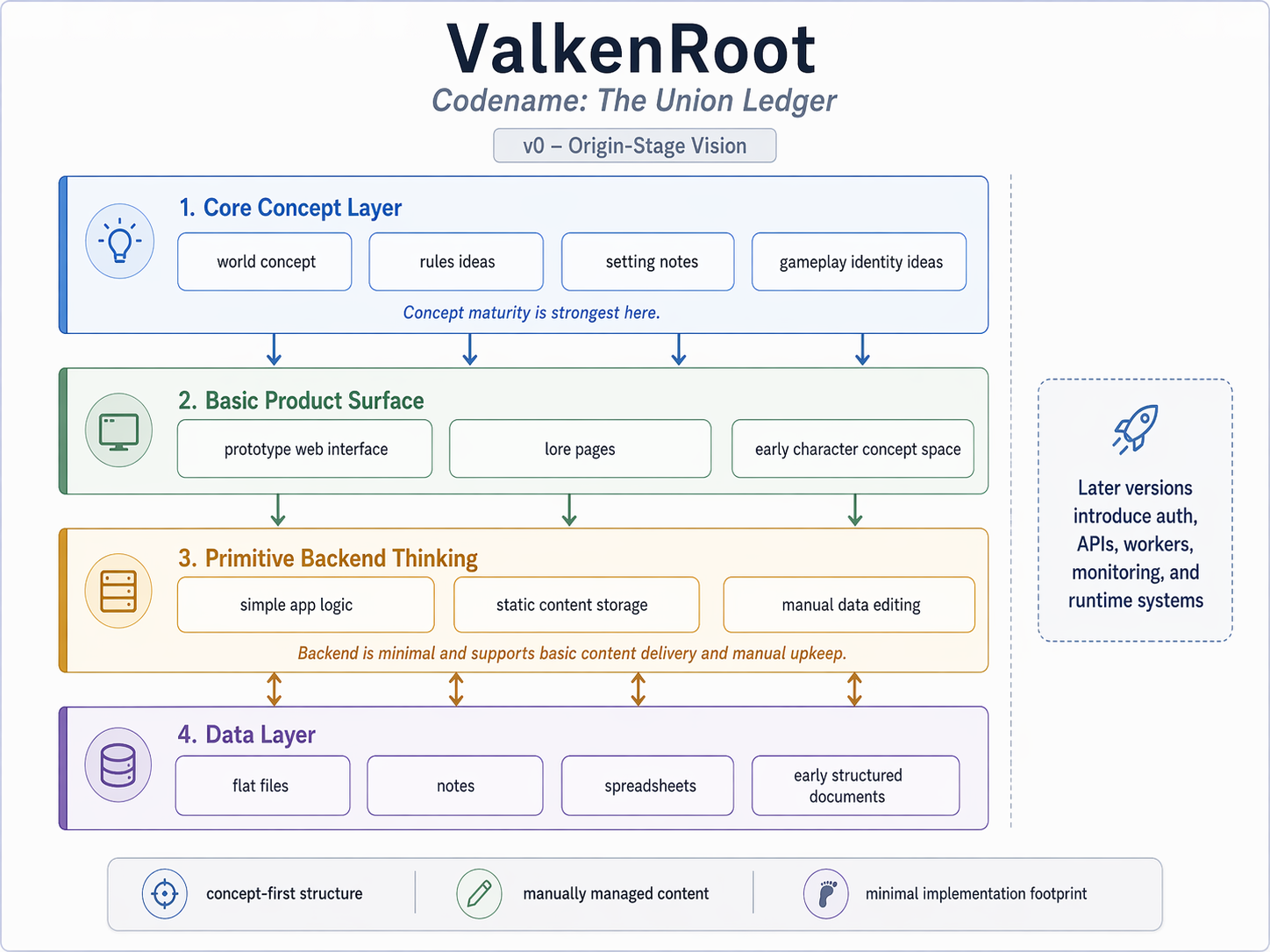
V0 application architecture diagram for ValkenRoot
App architectureConcept-stage application thinking before the platform matured.
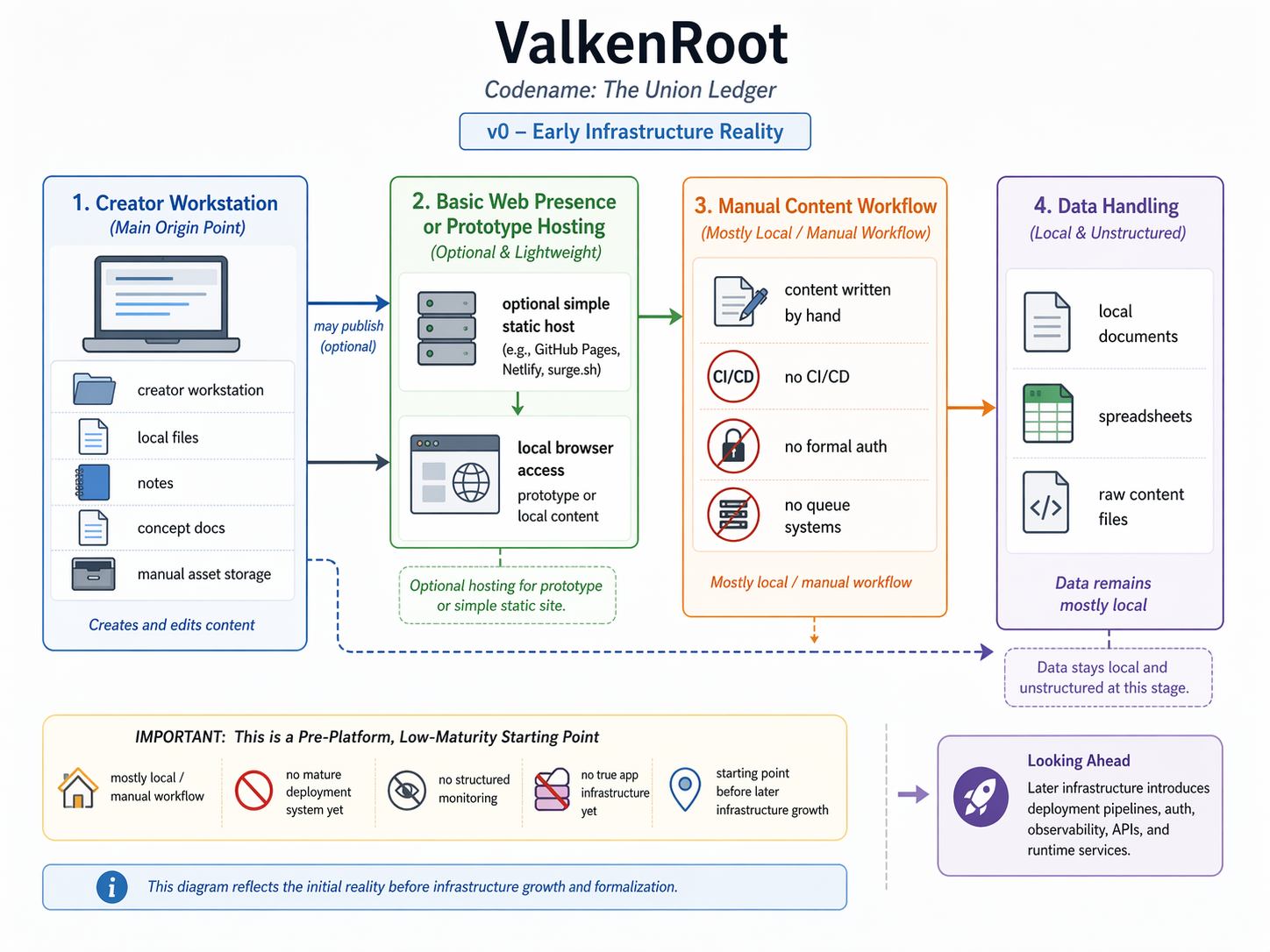
V0 infrastructure diagram for ValkenRoot
InfrastructureMinimal early-stage infrastructure with manual workflow and low formalization.
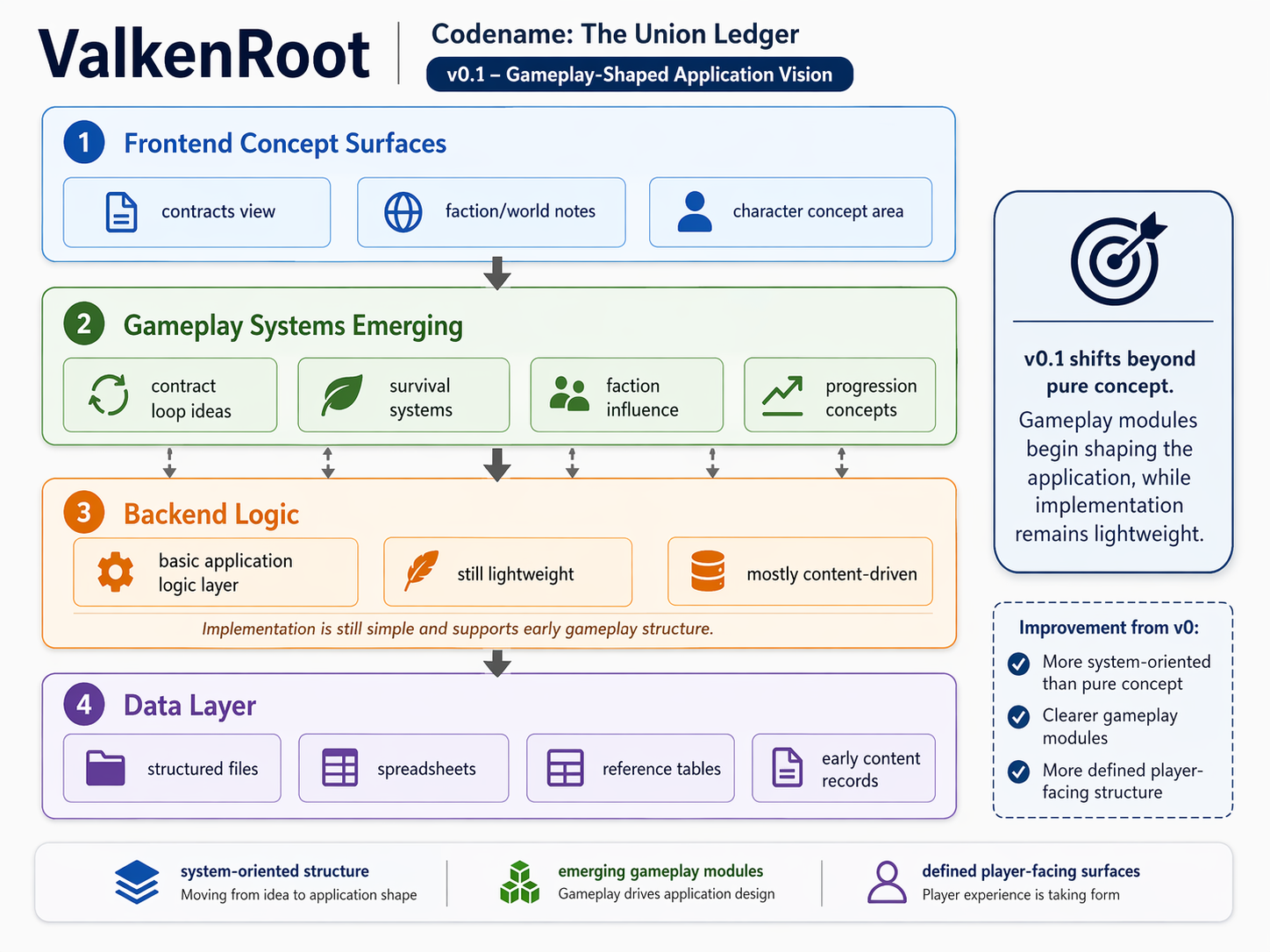
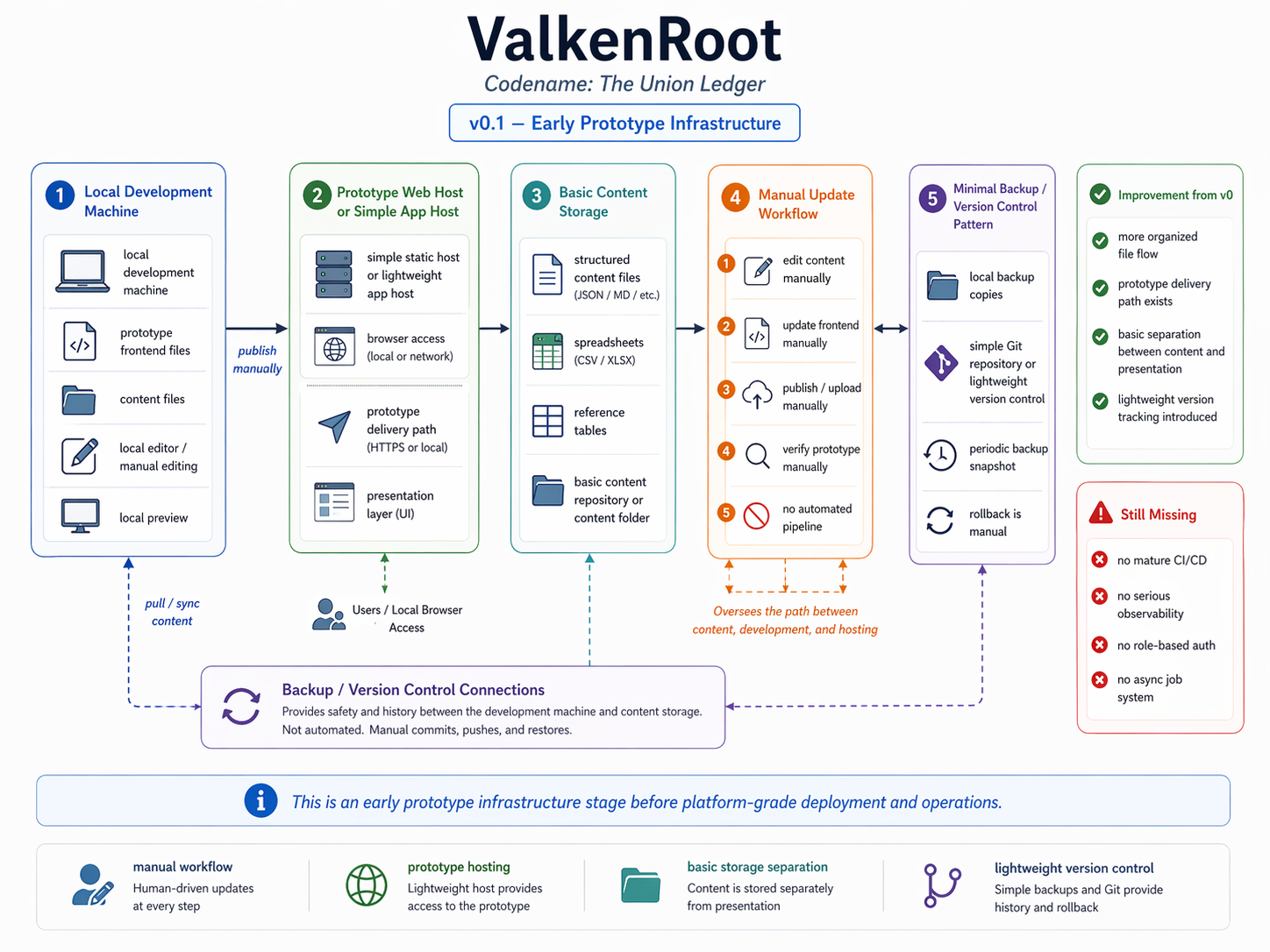
v0.1

Gameplay identity formation

This is where the project started making stronger claims about what kind of game experience it actually wanted to be.

Thinking at this stage

The emphasis shifted toward contracts, survival, factions, and a more grounded operator fantasy. The project began distinguishing itself from a generic fantasy adventure by centering labor, risk, and institutional pressure.

Why it mattered

This version gave the project its behavioral identity. Without this phase, later architecture could have been competent but generic. The product shape became clearer because the play shape became clearer.

V0.1 application architecture diagram for ValkenRoot
App architectureShows the first gameplay-driven structural organization.
V0.1 infrastructure diagram for ValkenRoot
InfrastructureShows the earliest move toward a more organized prototype environment.
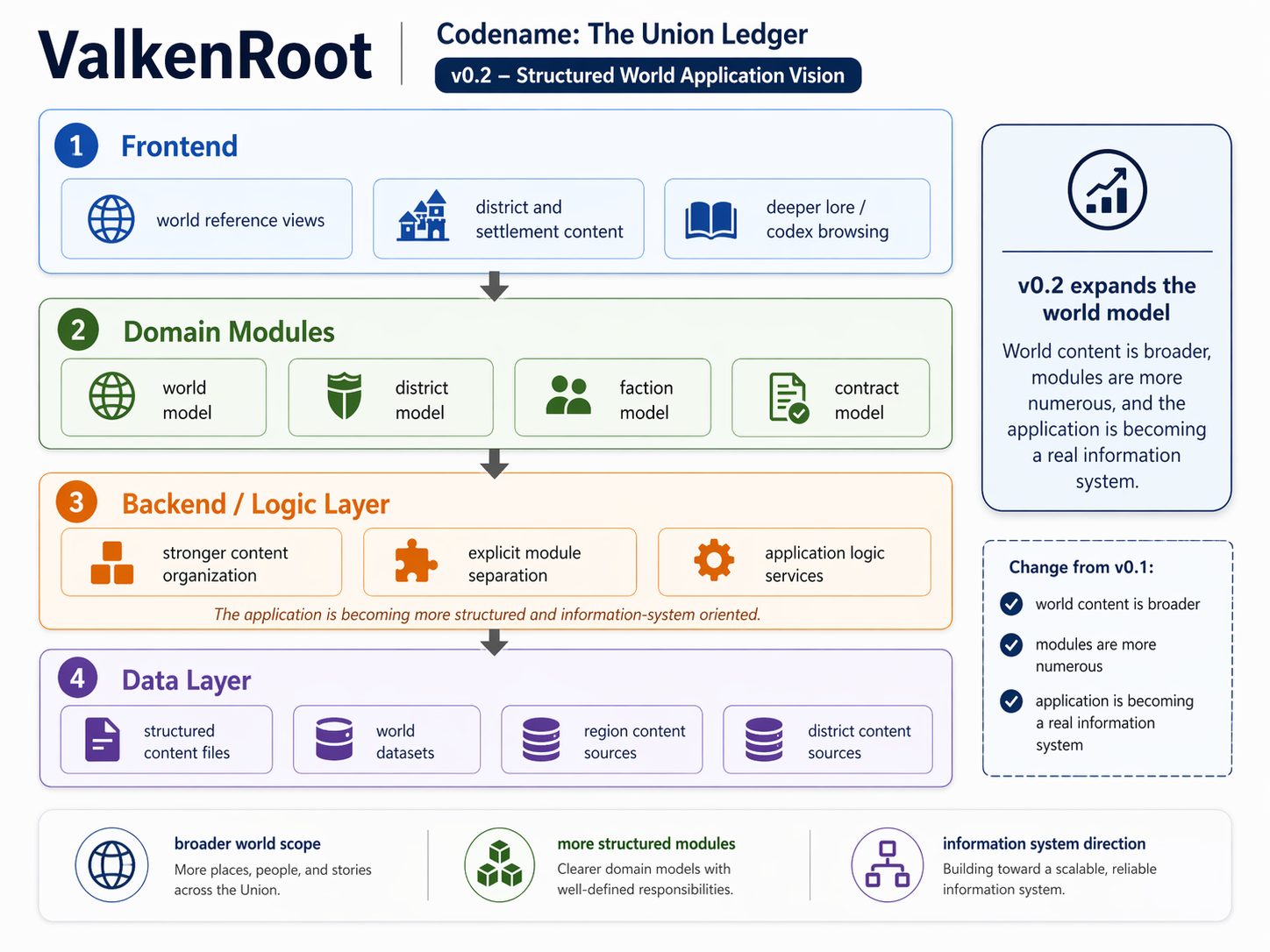
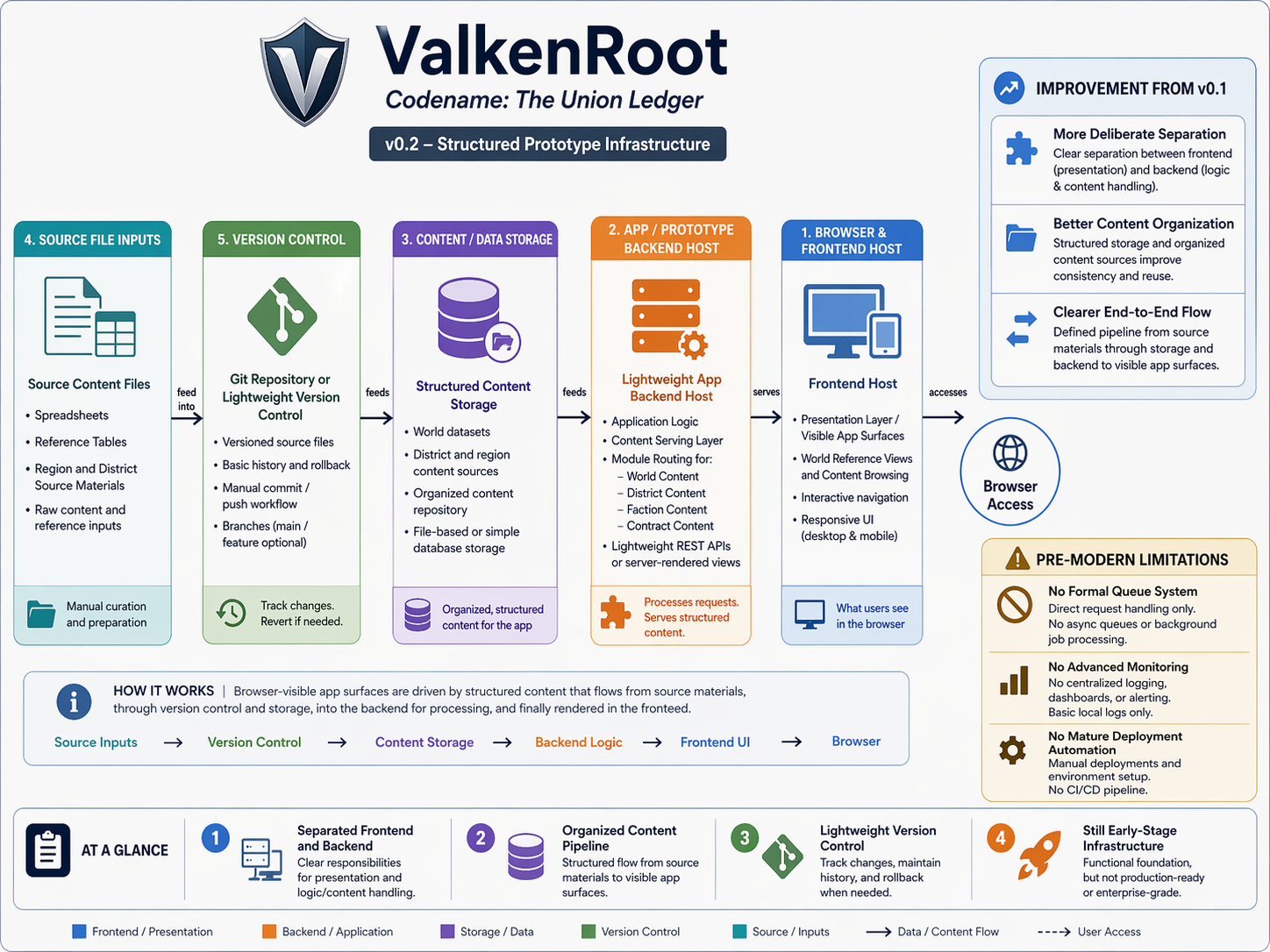
v0.2

World expansion

The setting became broader, more layered, and more structurally useful. Districts, regions, settlements, and faction presence started behaving like data as much as atmosphere.

Thinking at this stage

The work here was about making the world legible and scalable. A project like ValkenRoot cannot survive if the setting remains only descriptive; it has to be partitionable, referenceable, and eventually implementable.

Why it mattered

This stage laid the groundwork for later data modeling. Many of the later world, zone, and geography decisions only work because the setting was expanded in a way that made structure visible.

V0.2 application architecture diagram for ValkenRoot
App architectureShows the project reflecting a wider and more structured world model.
V0.2 infrastructure diagram for ValkenRoot
InfrastructureShows the growing separation between content organization and delivery surfaces.
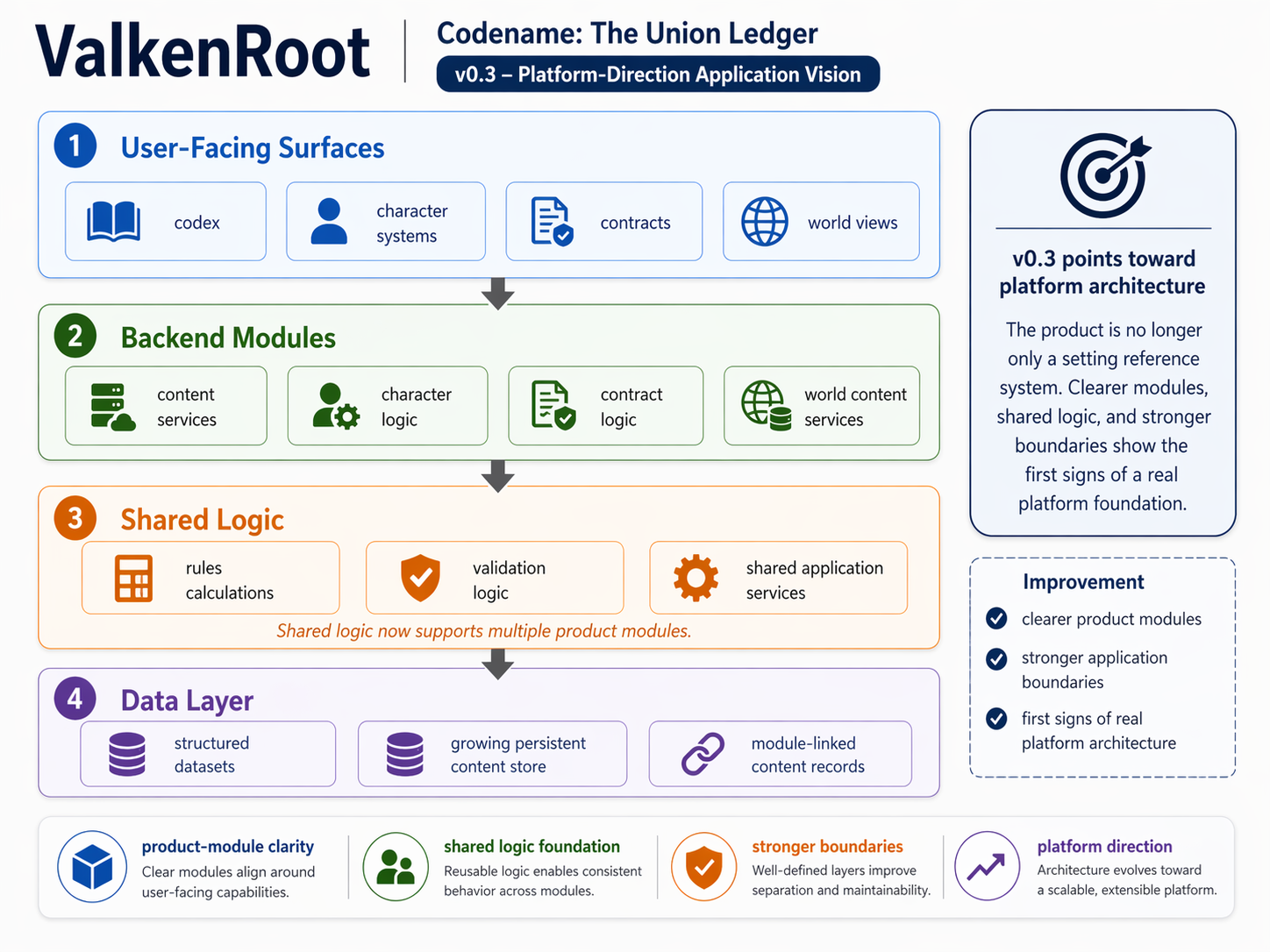
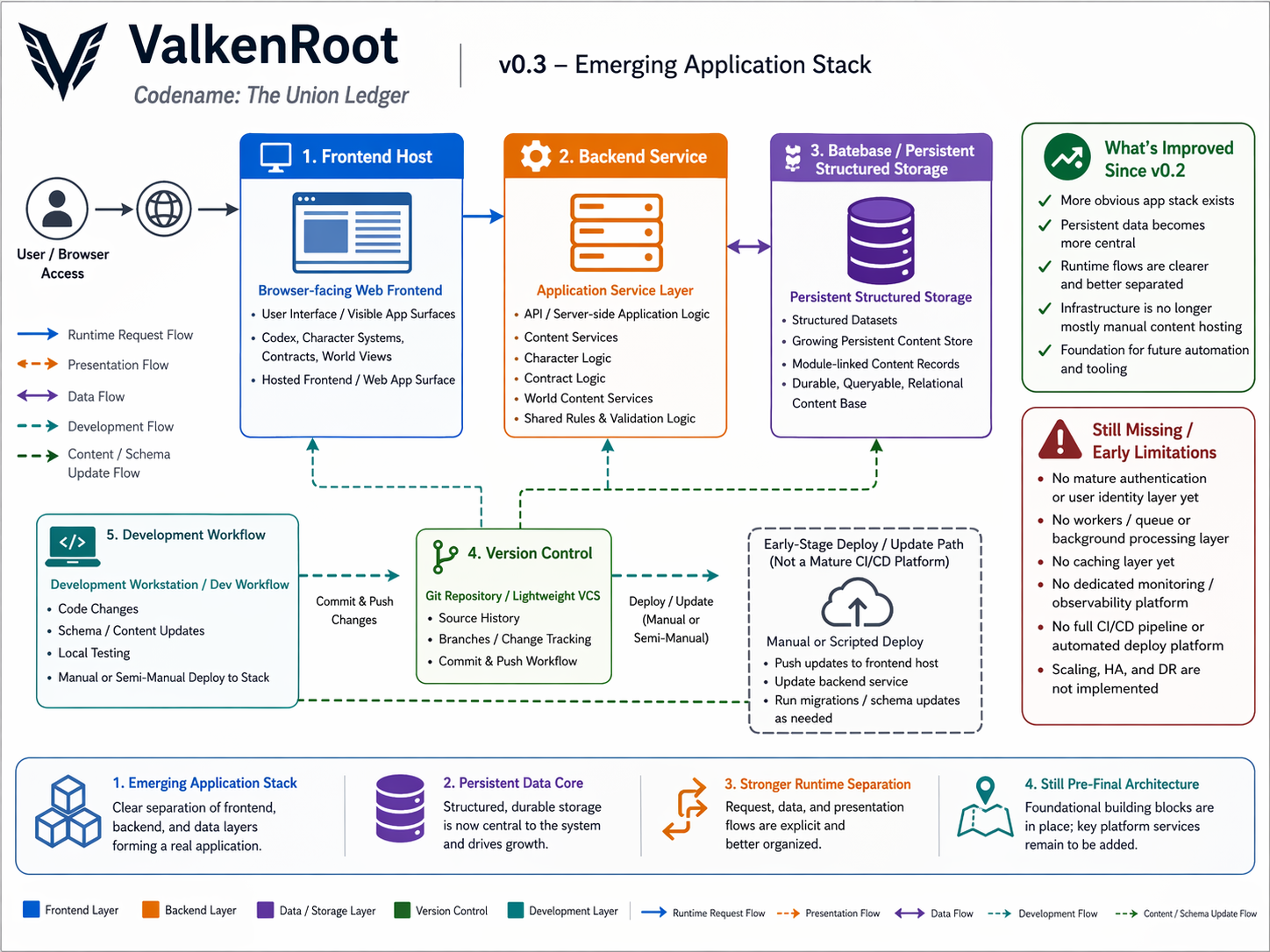
v0.3

Platform direction

The core project question shifted from "what is this world?" to "what does this become as an application?"

Thinking at this stage

This stage focused on identifying actual product surfaces: codex, characters, contracts, world reference, and administration. The project needed clearer user surfaces and logic zones rather than only more lore.

Why it mattered

This was the first serious move toward fullstack thinking. It made later backend, schema, and importer work much more natural because the user-facing surfaces had already been conceptually separated.

V0.3 application architecture diagram for ValkenRoot
App architectureShows the project becoming a product with defined user-facing modules.
V0.3 infrastructure diagram for ValkenRoot
InfrastructureShows the stack starting to move beyond manual or content-only structure.
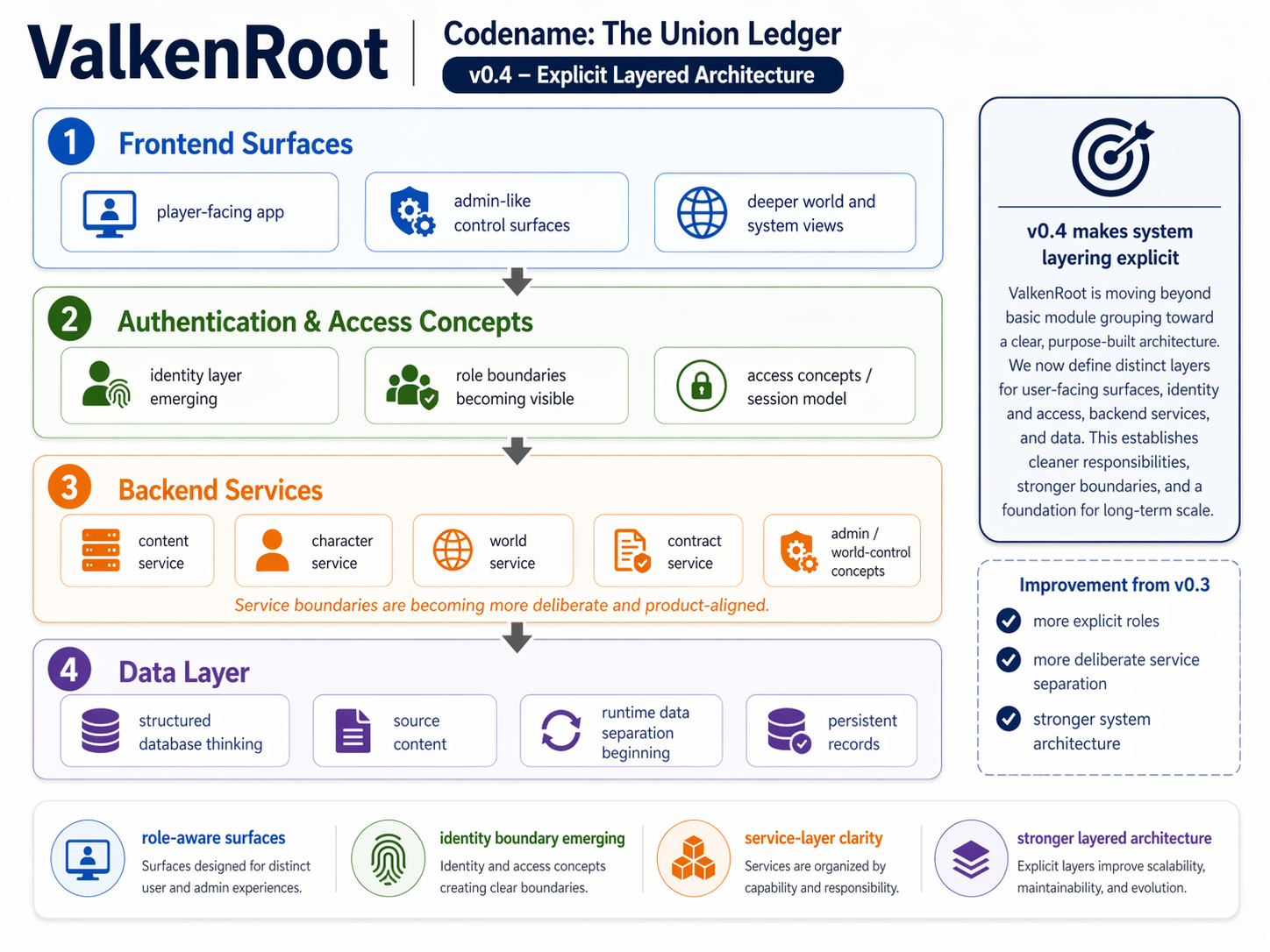
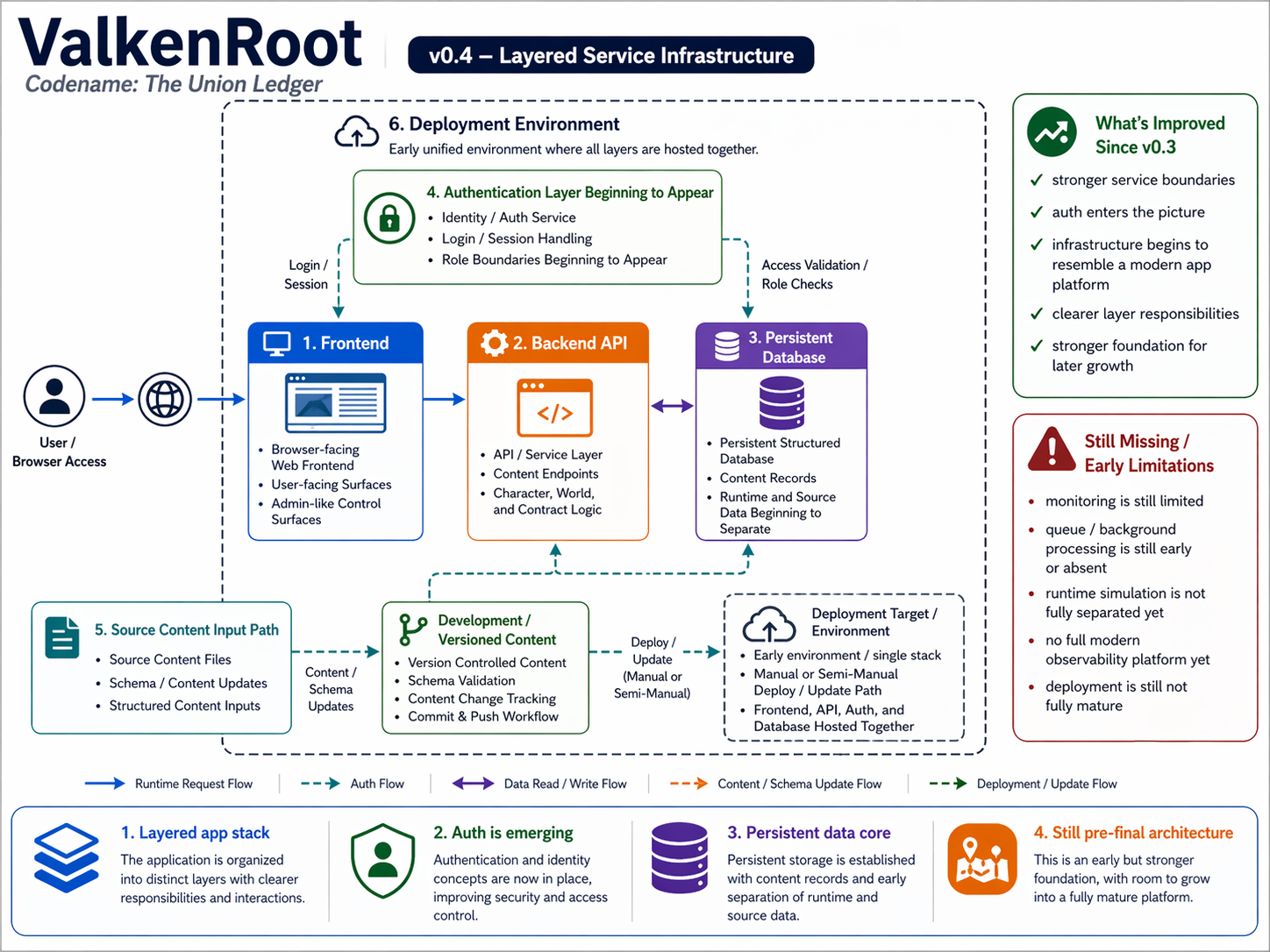
v0.4

System layering

This version is where the project began separating major concerns instead of letting everything live in one conceptual bucket.

Thinking at this stage

The design effort here focused on layers: user roles, service ownership, content structure, administrative control, and what the system would eventually need to support as it became more than a prototype.

Why it mattered

Without this layering step, later versions would have been forced to retrofit structure into an already tangled model. This is one of the key bridges from prototype thinking into platform thinking.

V0.4 application architecture diagram for ValkenRoot
App architectureShows clearer service separation and more explicit system boundaries.
V0.4 infrastructure diagram for ValkenRoot
InfrastructureShows the platform beginning to resemble a modern service environment.
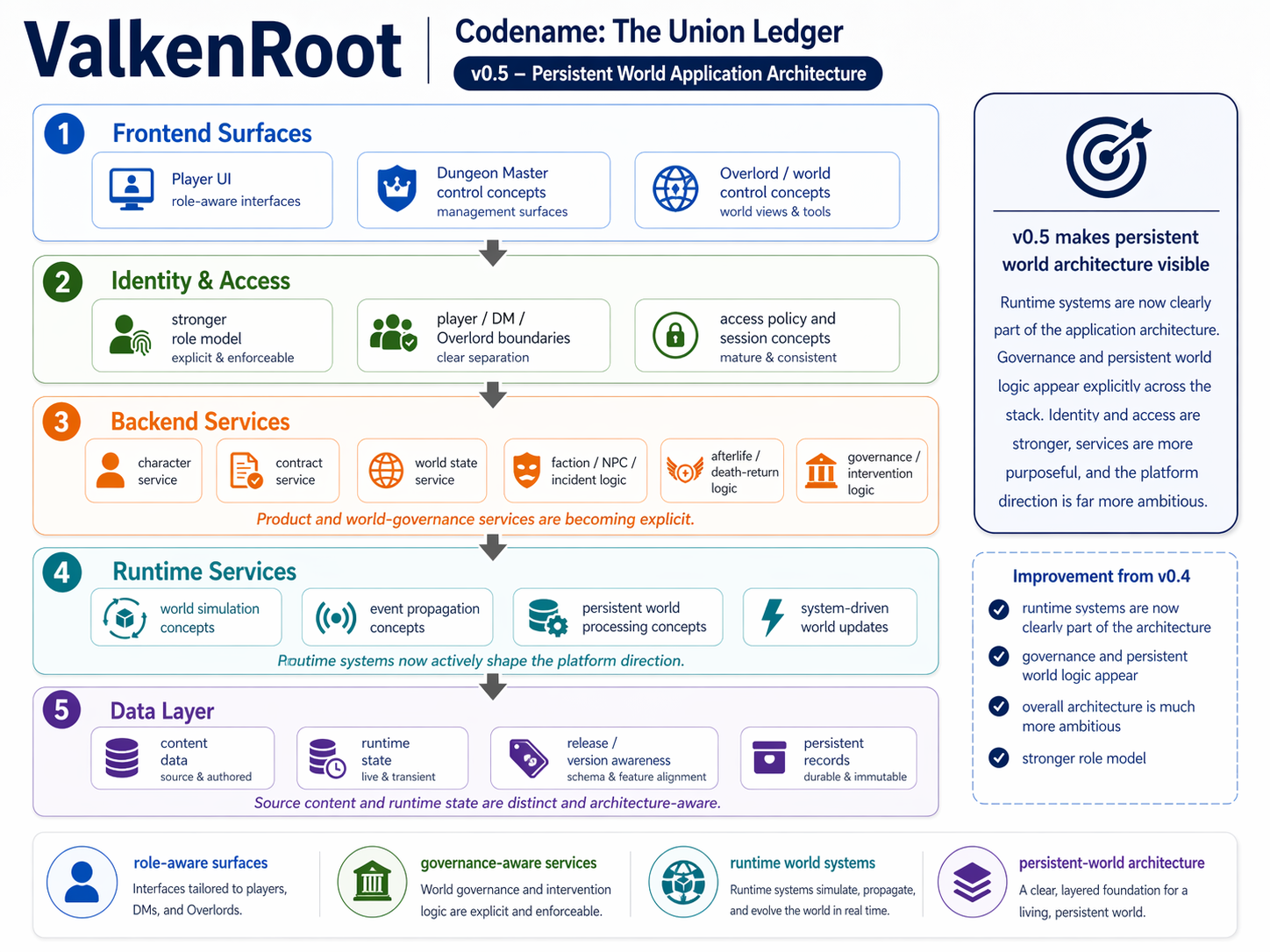
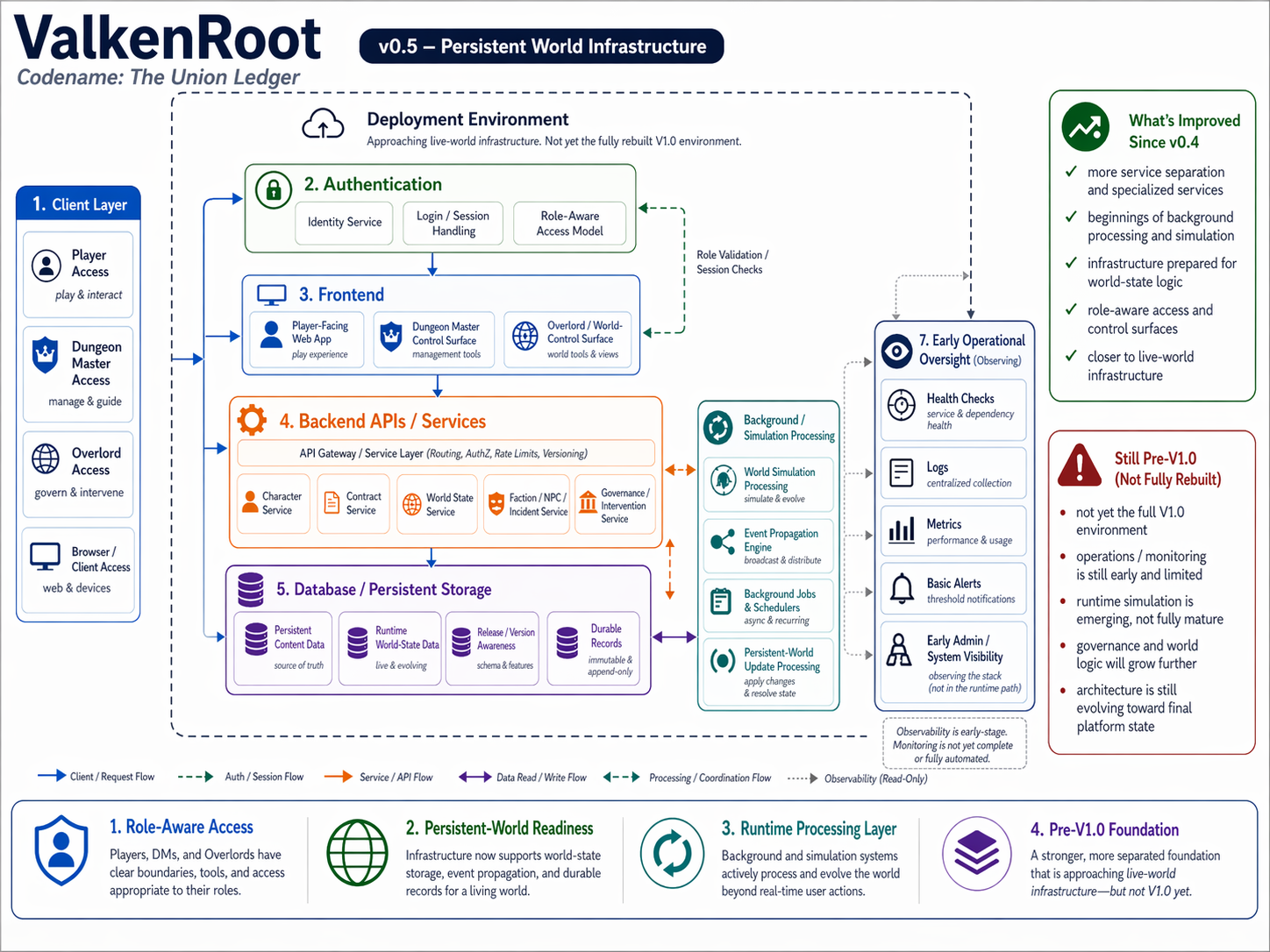
v0.5

Runtime ambition

This is the version where ValkenRoot stopped behaving like a rich setting project and started behaving like a candidate live-world platform.

Thinking at this stage

The important shift here was recognizing that contracts, factions, incidents, and the world itself should not remain static. Governance, persistent world pressure, and afterlife logic all started to move from narrative ideas into system design.

Why it mattered

This version exposed the scale problem. Once live-world behavior became part of the vision, the project needed stronger service separation, monitoring, async thinking, and more explicit operational boundaries.

V0.5 application architecture diagram for ValkenRoot
App architectureShows runtime systems and governance pressure becoming core parts of the application.
V0.5 infrastructure diagram for ValkenRoot
InfrastructureShows the infrastructure evolution needed to support persistent-world ambition.
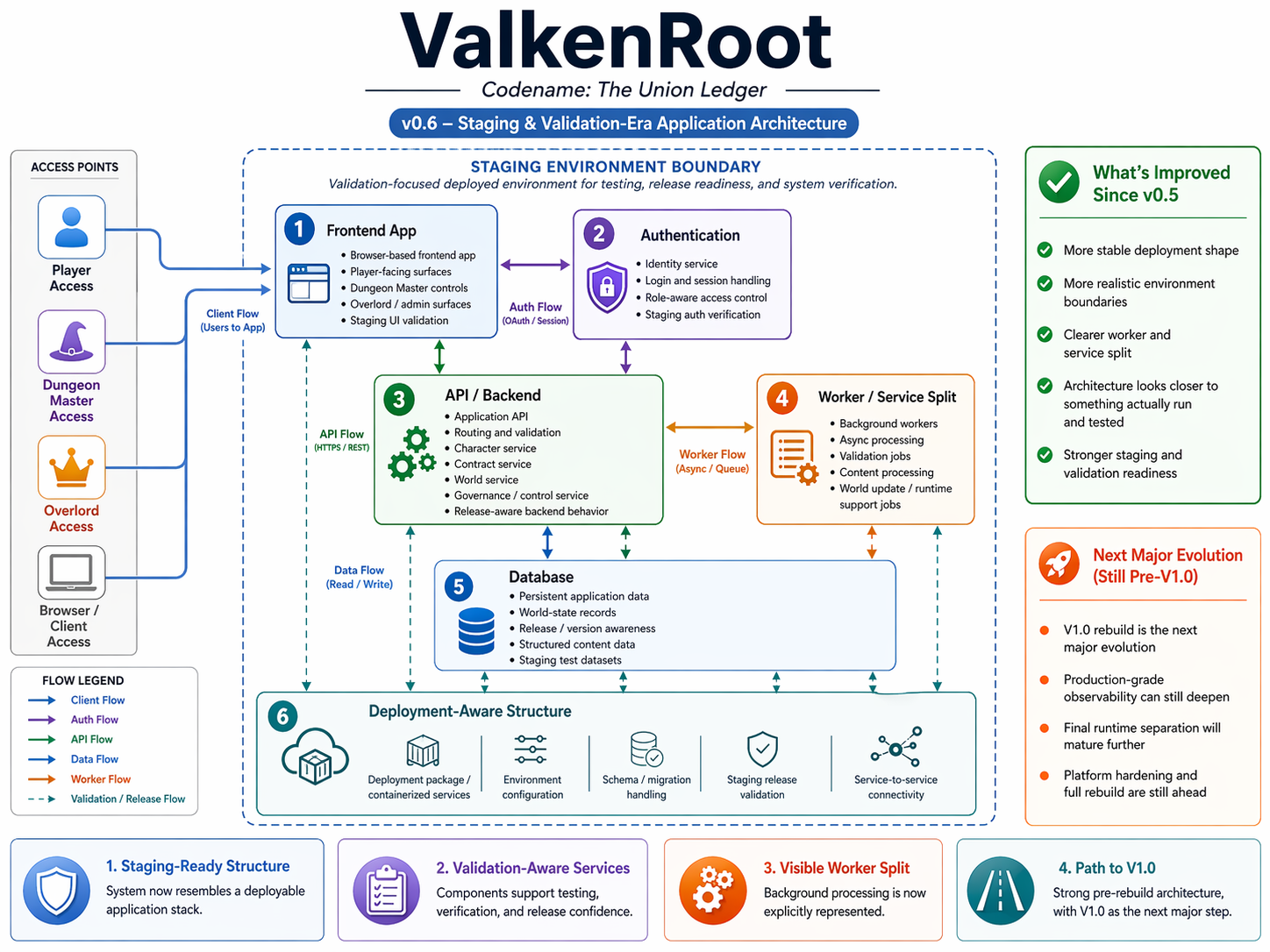
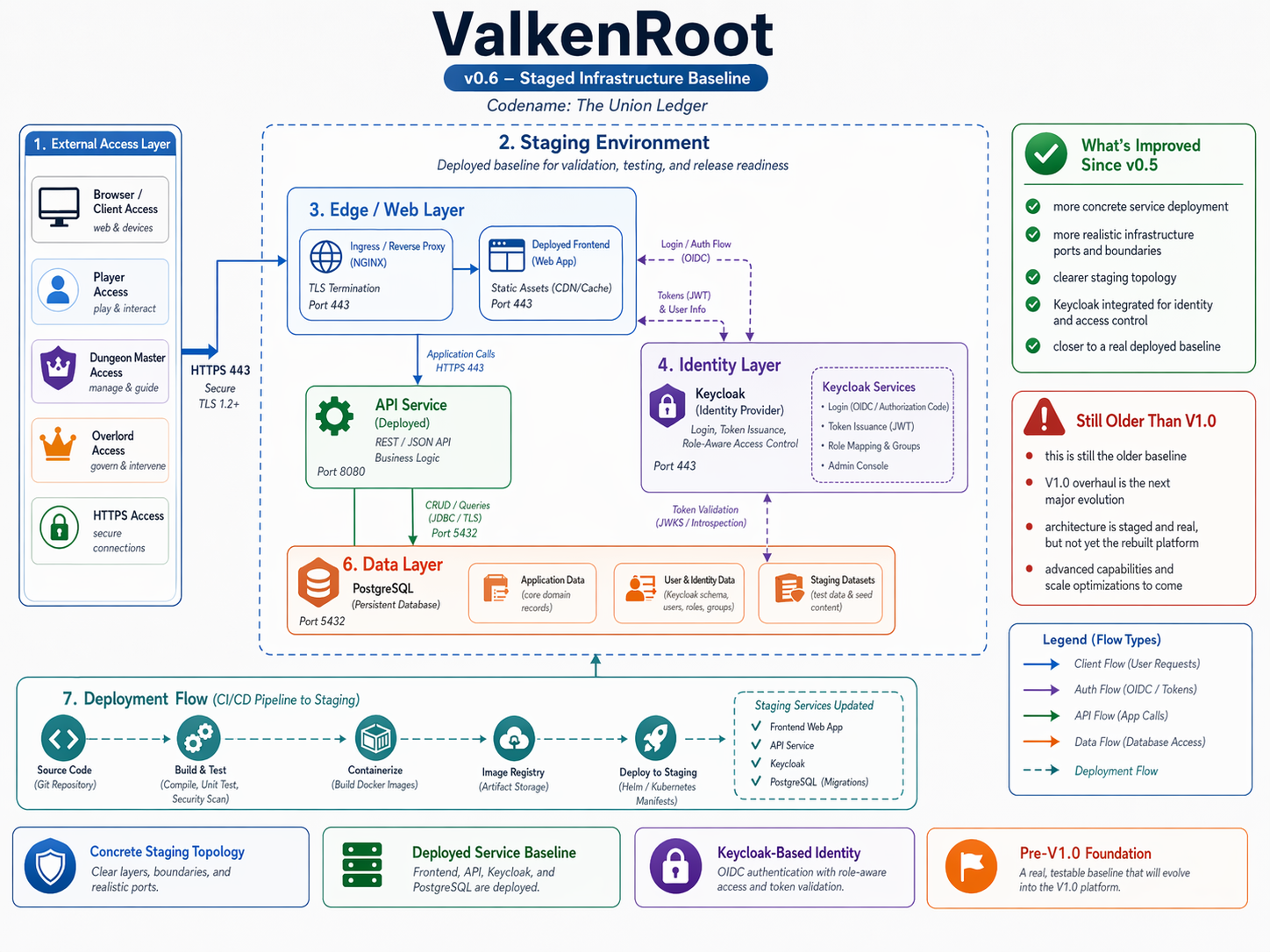
v0.6

Stage validation

This version represents the point where deployment and service coordination started to matter in a real operational sense. It acts as the proving ground before the new V1.0 rebuild takes over.

Thinking at this stage

The main concern here was not inventing more features. It was validating whether the project could be run, staged, and reasoned about as a real deployed system. This is where environment boundaries and service coordination became far more important.

Why it matters

Without a version like this, V1.0 would risk being planned in a vacuum. V0.6 is the operational memory that informs the later rebuild: what deployment friction exists, where auth and service shape matter, and what the next architecture must improve.

V0.6 application architecture diagram for ValkenRoot
App architectureShows a more realistic staged application structure and service layout.
V0.6 infrastructure diagram for ValkenRoot
InfrastructureShows staging-era deployment connectivity and baseline environment shape.

Security Posture

How ValkenRoot is being secured

V1.0 security is being shaped around role separation, protected delivery, private internal services, and stronger resistance to hostile access. The security model is being built as part of the platform architecture so that gameplay, governance, deployment, and monitoring evolve with clearer boundaries from the start.

Why security belongs in the portfolio

By V1.0, ValkenRoot is no longer only a game concept or a content-heavy design exercise. It is becoming a real application platform with multiple user types, privileged roles, protected data, CI/CD delivery, and internal operational surfaces. That makes security part of the architecture story rather than a separate later concern.

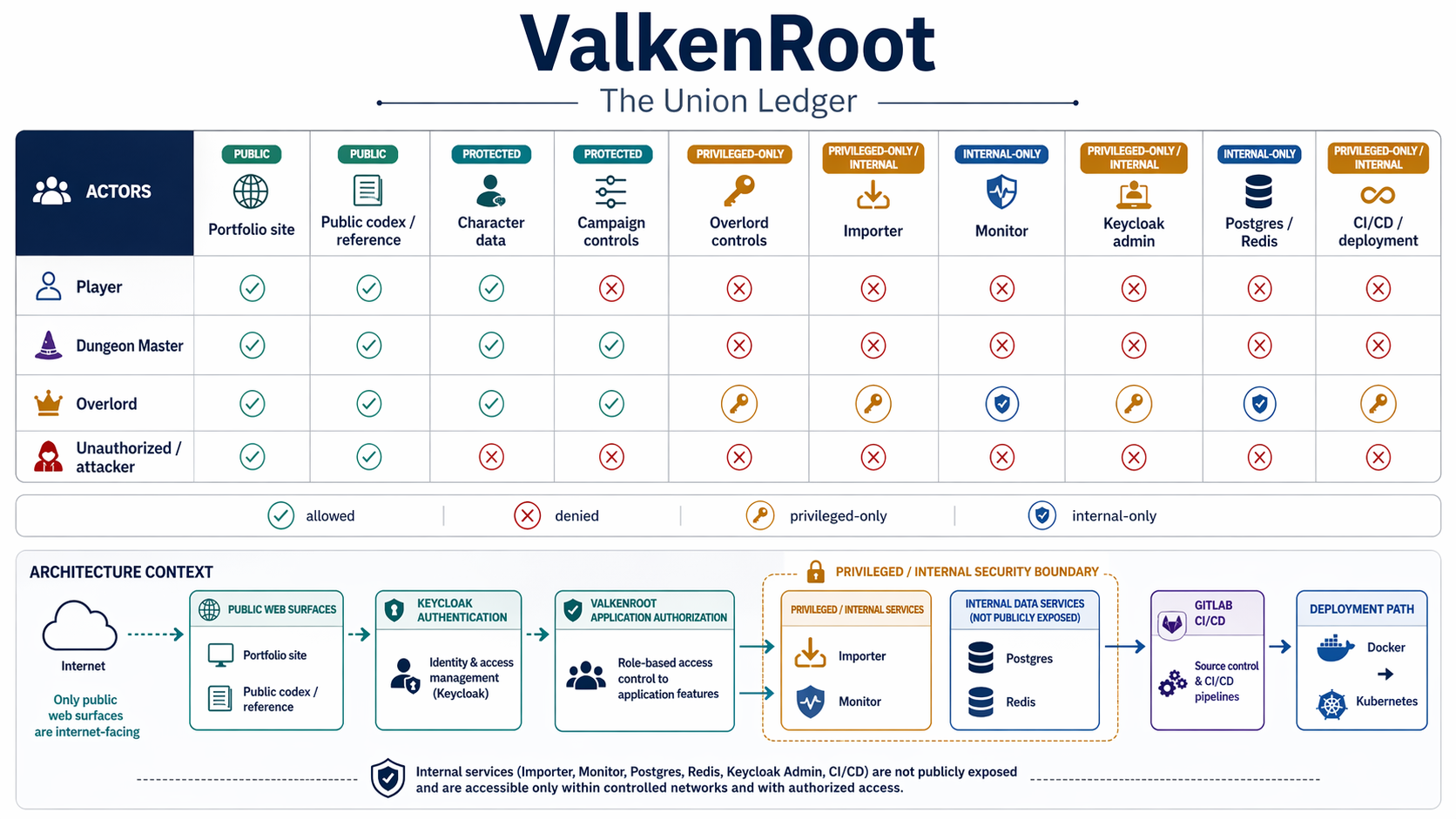
This section shows how the project is being shaped to withstand misuse, privilege abuse, and hostile access while still preserving the intended Player, Dungeon Master, and Overlord workflows.

What this section is showing

  • How role-based access is separated across player, campaign, world, and operations surfaces
  • How the current V1.0 design compares against major security frameworks
  • Where the project is already strong in security intent
  • Where practical implementation gaps still exist
  • How the hardening path moves from the current baseline toward safer staging and launch

Player

Players should be able to reach their own account, character, progression, campaign-linked gameplay surfaces, and approved public reference content.

They must not be able to reach importer tooling, Overlord governance, monitor administration, unrelated campaign data, or infrastructure-facing controls.

This boundary matters because player access is the most numerous and most exposed surface in the system. If it is not tightly scoped, normal gameplay identity can become an entry point into privileged platform behavior.

Dungeon Master

Dungeon Masters should be able to manage the campaigns they control, inspect campaign-linked characters, and operate encounter or campaign-specific tools.

They must not receive global world-governance powers, unrestricted importer access, or direct control over broader platform operations.

The key security design choice is that DM authority is campaign-scoped rather than global. A Dungeon Master is powerful inside the campaigns they run, but that should never collapse into system-wide administrative authority.

Overlord

Overlord is treated as a privileged application role with authority over world governance, release-aware content direction, and high-level intervention surfaces.

Even then, Overlord should not automatically imply infrastructure administration, unrestricted CI/CD access, or direct database control without separate operational privileges.

This separation is deliberate. Overlord is the highest application-governance role, but it is still not meant to be a blanket superuser over hosting, secrets, data stores, or deployment systems.

Unauthorized / attacker

Attackers are assumed to probe public APIs, replay tokens, enumerate identifiers, abuse privileged endpoints, and look for weak staging or default credentials.

The response is deny-by-default access, stronger edge filtering, rate limiting, private service networking, and enough telemetry to expose abuse early.

This card makes the threat model explicit: ValkenRoot assumes public-facing surfaces will be probed, so the framework is being shaped to resist enumeration, privilege escalation, and staging mistakes rather than trusting that those things will not happen.

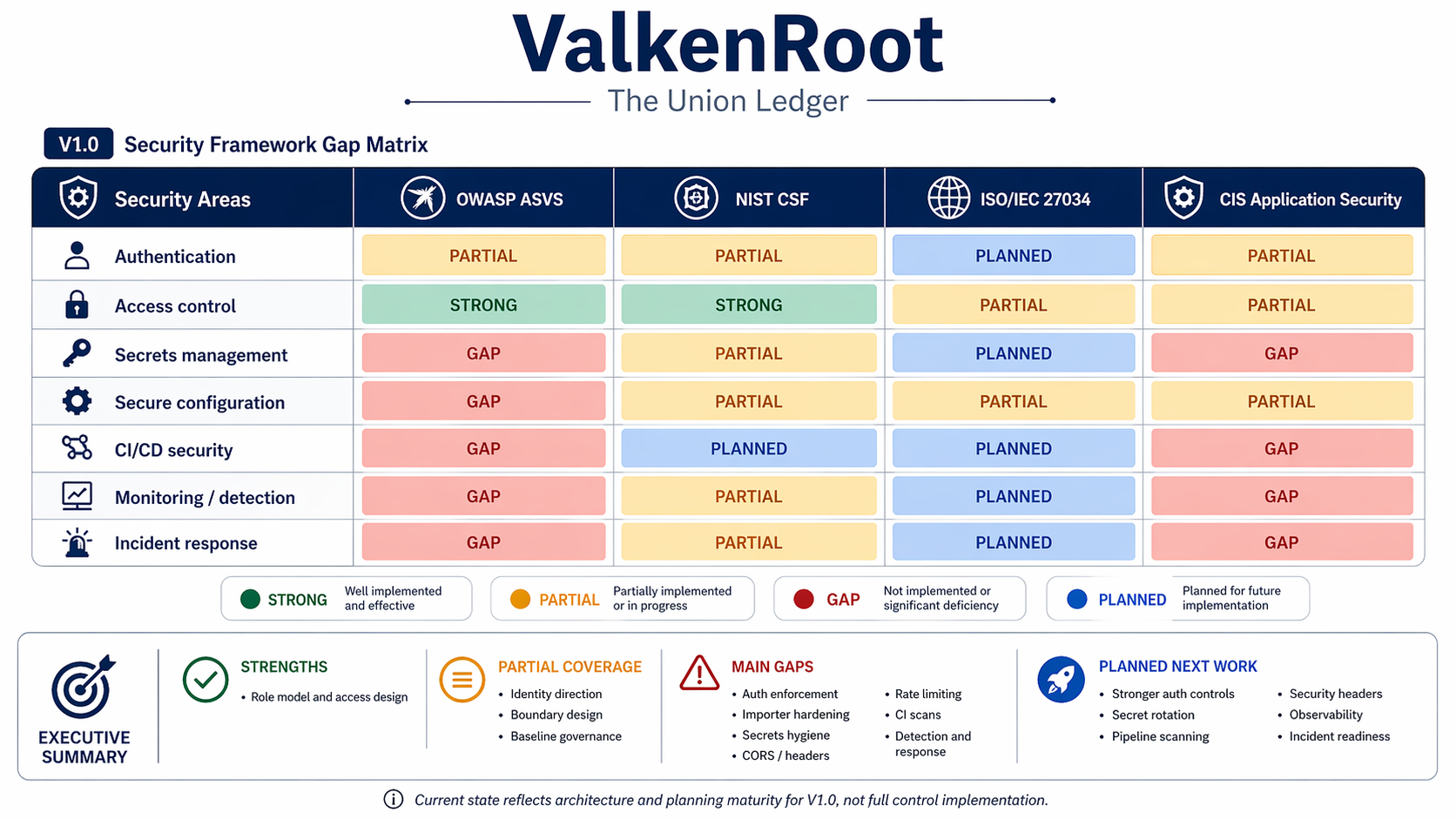
OWASP ASVS

The current design is strongest in role modeling, identity direction, and planned control boundaries.

It is still immature in applied controls such as strict CORS, route-level auth enforcement, hardened validation defaults, rate limiting, and importer protection.

In portfolio terms, this means the project already understands what needs to be protected, but some of the live defensive controls still need to be fully enforced in code and deployment.

NIST CSF

ValkenRoot already has a good architectural understanding of assets, actors, and operational surfaces.

The main gaps are in Protect, Detect, Respond, and Recover: security controls, abuse detection, response playbooks, and restore-tested recovery are not yet fully implemented.

The strongest current position is in Identify, because actors, services, and system roles are already being mapped clearly. The weaker areas are the operational disciplines that must come with an exposed or semi-exposed platform.

ISO/IEC 27034

The project is strong in planning and secure-by-design intent across the software lifecycle.

It still needs security to become a real SDLC gate through CI checks, environment separation, release controls, and operational policy enforcement.

This is an important distinction for V1.0: the planning is secure-by-design in intent, but the secure development lifecycle still has to be turned into concrete engineering rules and deployment gates.

CIS application security

The architecture is ready for practical hardening through configuration baselines, secrets discipline, and vulnerability management.

The biggest missing pieces are dependency scanning, secure configuration baselines, and stronger handling of credentials, internal service exposure, and monitoring.

This is the most practical hardening lens for the current stage because it translates architecture into service baselines, vulnerability management, and safer defaults that can actually be enforced during delivery.

Top security gaps right now

  • Route-level authentication and authorization enforcement
  • Importer protection and privileged route lock-down
  • Secret hygiene and removal of weak or default credentials
  • CORS, headers, and request hardening at the API edge
  • Rate limiting and abuse protection
  • CI security scanning and deployment safety gates
  • Audit logging, detection, and security-focused monitoring

These are the highest-priority weaknesses because they sit directly on the boundary between the intended role model and the real attack surface. They represent the difference between good architectural intent and a launch-ready defensive posture.

Hardening direction

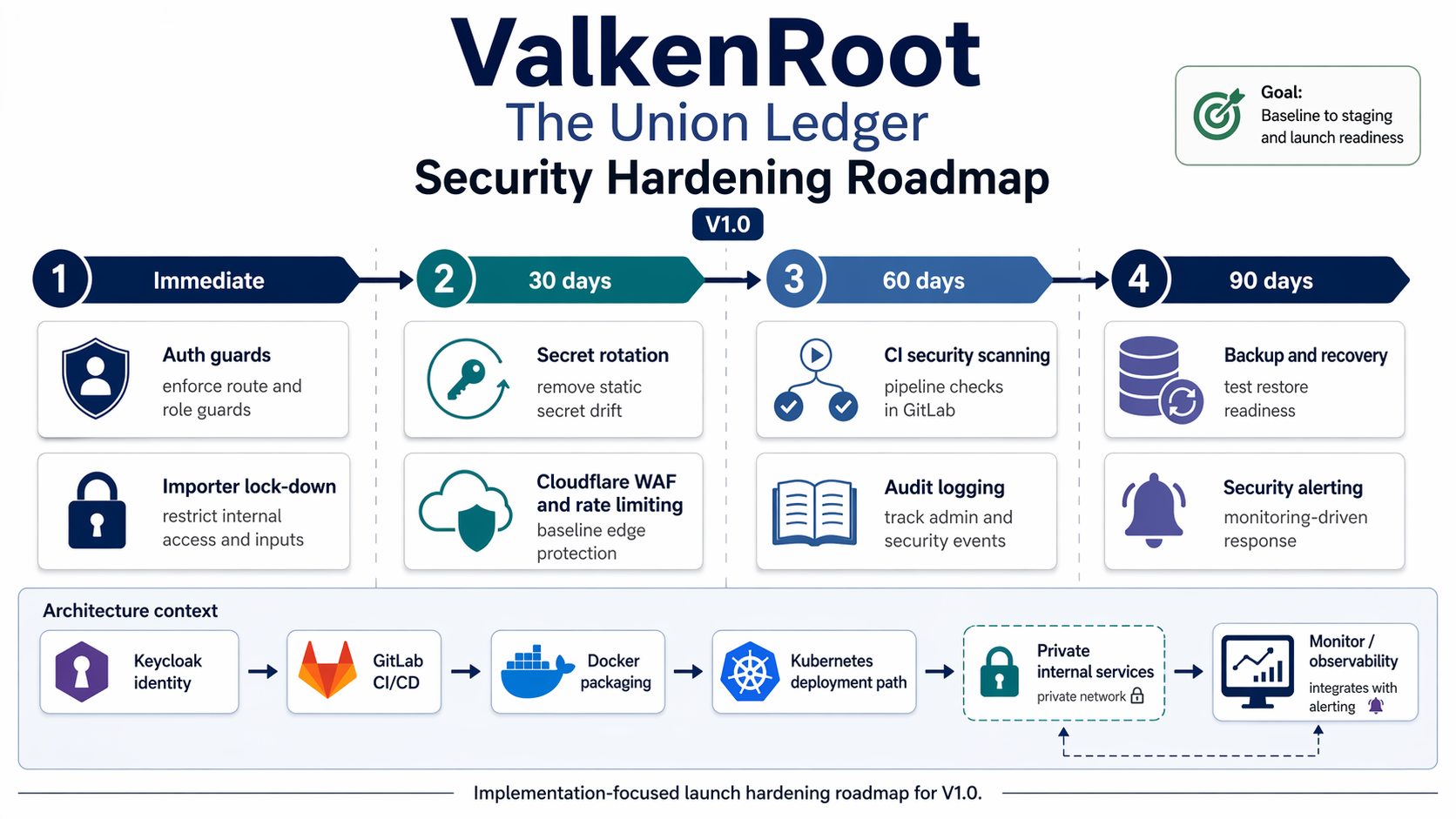
The hardening path is to put Cloudflare edge protection in front of the public surface, enforce strict role boundaries inside the API, keep internal services private, add GitLab security gates to delivery, and feed security telemetry into the monitoring stack.

That gives ValkenRoot a practical launch-ready baseline while preserving the longer path toward richer world systems, operations tooling, and governance layers.

The emphasis is on realistic hardening rather than overbuilding: secure the edge, secure the roles, secure the pipeline, secure the internal services, and make abuse visible enough that the team can respond early.
Security role access matrix for ValkenRoot
40_security_role_access_matrix.png Shows which actors can reach which application and operational surfaces.
Role access matrix Shows how Player, Dungeon Master, Overlord, and attacker paths map to public, privileged, and internal-only surfaces. This visual makes the privilege model immediately legible by showing where normal gameplay access ends, where campaign authority begins, where world governance starts, and where the system should shut hostile access down entirely.
Security framework gap matrix for ValkenRoot
41_security_framework_gap_matrix.png Shows current security maturity against major frameworks.
Framework gap matrix Summarizes where the current V1.0 design is strong, partial, or still missing important controls. It translates the security discussion into a framework view so the current state can be read as a maturity snapshot rather than as an abstract list of concerns.
Security hardening roadmap for ValkenRoot
42_security_hardening_roadmap.png Shows the phased path from the current baseline to safer staging and launch posture.
Security hardening roadmap Shows the immediate, 30-day, 60-day, and 90-day hardening path for the ValkenRoot platform. This roadmap turns the security posture into an implementation story by showing how the framework moves from planning and baseline controls into stronger launch-ready protections over time.